
Neuroart in Headache: visualizing the migraine experience through patient expression
DOI:
https://doi.org/10.48208/HeadacheMed.2026.24Keywords:
Migraine, Headache, Medicine in the arts, Art, Pain perceptionAbstract
Introduction
Migraine is a highly prevalent neurological disorder affecting individuals across all ages, often characterized by recurrent attacks of severe headache and associated symptoms that profoundly impact quality of life. Beyond clinical descriptions, the subjective experience of migraine remains difficult to convey. Years ago, we introduced a section entitled Neuroart in Headache to capture artistic expressions of patients and individuals engaged in the arts, illustrating how migraine is perceived and lived. Artistic depictions—found in literature, cinema, theater, and visual arts—frequently use headache as both a literal and metaphorical representation of suffering.
Objective
To present artistic representations of migraine created by patients and discuss their potential contribution to understanding the lived experience of the disease.
Methods
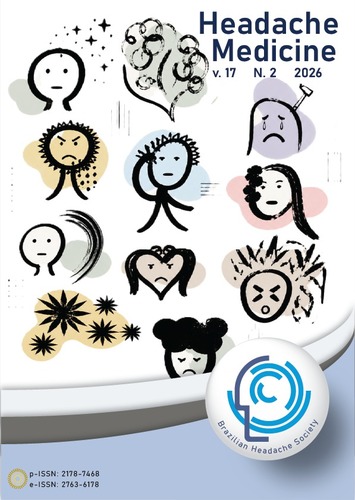
Eighteen patients with headache disorders were invited to illustrate their experience of pain through freehand drawings during the celebration of 20 years of physiotherapy in headache management. Clinical diagnoses were established according to the International Classification of Headache Disorders, 3rd edition (ICHD-3). The drawings were analyzed using a narrative descriptive approach and are presented as 18 illustrative images depicting different dimensions of headache.
Results
The drawings revealed recurring representations of progressive pain, pressure, pulsation, visual aura, emotional distress, sadness, disability, and the impact of headache on daily activities. Although each illustration reflected an individual experience, common themes emerged across patients, highlighting the multidimensional sensory, cognitive, emotional, and functional burden of headache disorders.
Conclusion
Neuroart emerges as a valuable complementary tool for understanding headache disorders by bridging the gap between clinical observation and patients' lived experiences. Artistic expression provides unique insights into the invisible burden of migraine and may contribute to more empathetic communication and patient-centered care.
Downloads
References
1. Ashina M. Migraine. New England Journal of Medicine 2020;383:1866–76. Doi:10.1056/NEJMra1915327. DOI: https://doi.org/10.1056/NEJMra1915327
2. Forte G, Favieri F, De Pascalis V, Casagrande M. To Be in Pain: Pain Multidimensional Questionnaire as Reliable Tool to Evaluate Multifaceted Aspects of Pain. J Clin Med 2024;13. Doi:10.3390/jcm13195886. DOI: https://doi.org/10.3390/jcm13195886
3. HONKASALO M-L. Space and Embodied Experience: Rethinking the Body in Pain. Body Soc 1998;4:35–57. Doi:10.1177/1357034X98004002003. DOI: https://doi.org/10.1177/1357034X98004002003
4. Padfield D, Wickenden M. Being in Pain: Using Images and Participatory Methods to Explore Intercultural Understanding of Pain. Teaching and Learning in Higher Education: The Context of Being, Interculturality and New Knowledge Systems, Emerald Publishing Limited; 2021, p. 145–58. Doi:10.1108/978-1-80043-006-820211010. DOI: https://doi.org/10.1108/978-1-80043-006-820211010
5. Headache Classification Committee of the International Headache Society (IHS) The International Classification of Headache Disorders, 3rd edition. Cephalalgia 2018;38:1–211. Doi:10.1177/0333102417738202. DOI: https://doi.org/10.1177/0333102417738202
6. Lou J, Pourkazemi F, Mackenzie L. Exploring the experiences of individuals living with persistent pain using a visual art diary. British Journal of Occupational Therapy 2022;85:712–21. Doi:10.1177/03080226221079239. DOI: https://doi.org/10.1177/03080226221079239
7. Vick RM, Sexton-Radek K, Kaplan FF. Art and Migraine: Researching the Relationship Between Artmaking and Pain Experience. Art Therapy 2009;26:114–23. Doi:10.1080/07421656.2009.10129371. DOI: https://doi.org/10.1080/07421656.2009.10129371
8. Haan J, Ferrari MD. Picasso’s migraine: Illusory cubist splitting or illusion? Cephalalgia 2011;31:1057–60. Doi:10.1177/0333102411406752. DOI: https://doi.org/10.1177/0333102411406752
9. Padfield D, Zakrzewska JM. Encountering pain: images as a tool for collaborative approaches to pain medicine. Pain 2026;167:1252–62. Doi:10.1097/j.pain.0000000000003973. DOI: https://doi.org/10.1097/j.pain.0000000000003973
Downloads
Published
Issue
Section
License
Copyright (c) 2026 Daniella Araújo de Oliveira, Juliana Ramos de Andrade, Marcelo Moraes Valença (Author)

This work is licensed under a Creative Commons Attribution 4.0 International License.












